Reynolds number
The Reynolds number says how big and how fast a wing is, in the one way that matters to the air or water flowing over it. Two sections at the same Reynolds number behave the same whether one is a model and the other is full size. It is the first thing to get right before reading any polar on this site.
What it is
Re = V · c / ν
- V is the speed through the fluid, in m/s.
- c is the chord, in m.
- ν (nu) is the fluid's kinematic viscosity: how "thick" it is relative to its density. Air is about 1.5 × 10⁻⁵ m²/s, water about 1 × 10⁻⁶. The same section at the same speed and chord sits at roughly fifteen times the Reynolds number in water as in air.
Low Reynolds numbers (below about 200,000) mean the boundary layer stays laminar for a long way and can separate in a bubble, so drag is high and jumpy and stall comes early. High Reynolds numbers (above a million) mean a thinner, more turbulent boundary layer, lower drag, higher maximum lift, and a later stall. The transition between those regimes is where most small aircraft and all hydrofoils live, which is why the number matters.
Work it out
Multiply speed by chord and divide by the viscosity of your fluid. The table uses the constants the site itself uses.
| Craft | Fluid | Speed | Chord | ν (m²/s) | Re |
|---|---|---|---|---|---|
| Indoor or park flyer | air | 8 m/s | 150 mm | 1.46e-5 | 8.2e4 |
| RC glider, 2 m span | air | 12 m/s | 180 mm | 1.46e-5 | 1.5e5 |
| Quadcopter propeller, 75% radius | air | 60 m/s | 25 mm | 1.46e-5 | 1.0e5 |
| Paramotor or ultralight wing | air | 15 m/s | 1500 mm | 1.46e-5 | 1.5e6 |
| Light aircraft at cruise | air | 55 m/s | 1400 mm | 1.46e-5 | 5.3e6 |
| Kite or wing foil front wing | sea water | 8 m/s | 120 mm | 1.05e-6 | 9.1e5 |
| Pumping foil, slow | sea water | 4 m/s | 100 mm | 1.05e-6 | 3.8e5 |
| Fast hydrofoil, race | sea water | 15 m/s | 90 mm | 1.05e-6 | 1.3e6 |
| Model yacht keel fin | fresh water | 1.5 m/s | 80 mm | 1.14e-6 | 1.1e5 |
Source: ν = μ/ρ with ρ, μ: air 1.225, 0.00001789 (app/utils/operating-envelope.ts); sea water 1025, 0.00108 (same); fresh water 999.1, 0.001139 (app/input, ITTC 15 °C). Chords are typical, not measured.
Rules of thumb: in air, Re ≈ 68,000 × V (m/s) × c (m); in sea water, Re ≈ 950,000 × V × c. A hydrofoil with a 100 mm chord at 10 m/s is at about a million. A 150 mm RC wing at 10 m/s is at about 100,000.
What it changes
Everything on a polar moves with Re: minimum drag, maximum lift, the best lift-to-drag ratio and the angle it occurs at. The stored sweep lets you see how much.
| Re | CD min | CL max | (L/D) max | at α | at CL |
|---|---|---|---|---|---|
| 50k | 0.0221 | 1.19 | 32 | 7.5° | 0.99 |
| 100k | 0.0159 | 1.29 | 50 | 6.5° | 0.93 |
| 200k | 0.0100 | 1.35 | 67 | 6.0° | 0.89 |
| 500k | 0.0064 | 1.40 | 88 | 5.0° | 0.81 |
| 1M | 0.0055 | 1.54 | 100 | 5.0° | 0.81 |
| 2M | 0.0052 | 1.65 | 110 | 4.5° | 0.75 |
| 5M | 0.0052 | 1.74 | 122 | 8.0° | 1.13 |
Source: Stored NeuralFoil polars for naca2412 (https://foil.tools/api/polars/naca2412), read 2026-11-05; minimum CD and best L/D over α -5° to 15°.
| Re | CD min | CL max | (L/D) max | at α | at CL |
|---|---|---|---|---|---|
| 50k | 0.0201 | 1.28 | 35 | 6.5° | 1.03 |
| 100k | 0.0153 | 1.32 | 55 | 6.0° | 0.99 |
| 200k | 0.0091 | 1.33 | 75 | 5.0° | 0.90 |
| 500k | 0.0058 | 1.37 | 99 | 4.0° | 0.79 |
| 1M | 0.0049 | 1.47 | 115 | 4.0° | 0.80 |
| 2M | 0.0048 | 1.61 | 128 | 5.0° | 0.91 |
| 5M | 0.0049 | 1.76 | 147 | 5.0° | 0.92 |
Source: Stored NeuralFoil polars for sd7037 (https://foil.tools/api/polars/sd7037), read 2026-11-05; minimum CD and best L/D over α -5° to 15°.
Read across a row to compare sections at one Reynolds number, and down a column to see what a change of speed or chord does to one section. Minimum drag roughly halves between 100k and 1M; the best L/D roughly doubles.
Where to type it
- Foil page: the stored sweep covers 14 Reynolds numbers from 20,000 to 10,000,000. Tick the ones near yours in the Reynolds Numbers list. For the exact value, type it in "Run it at your Reynolds number" (340000, 340k or 3.4e5) and NeuralFoil computes that polar now.
- Compare: the Reynolds Numbers field under the analysis options takes a comma-separated list.
- Mission: you type mass, area, span, speed and fluid, and the page works out the Reynolds number and the lift coefficient for each operating point.
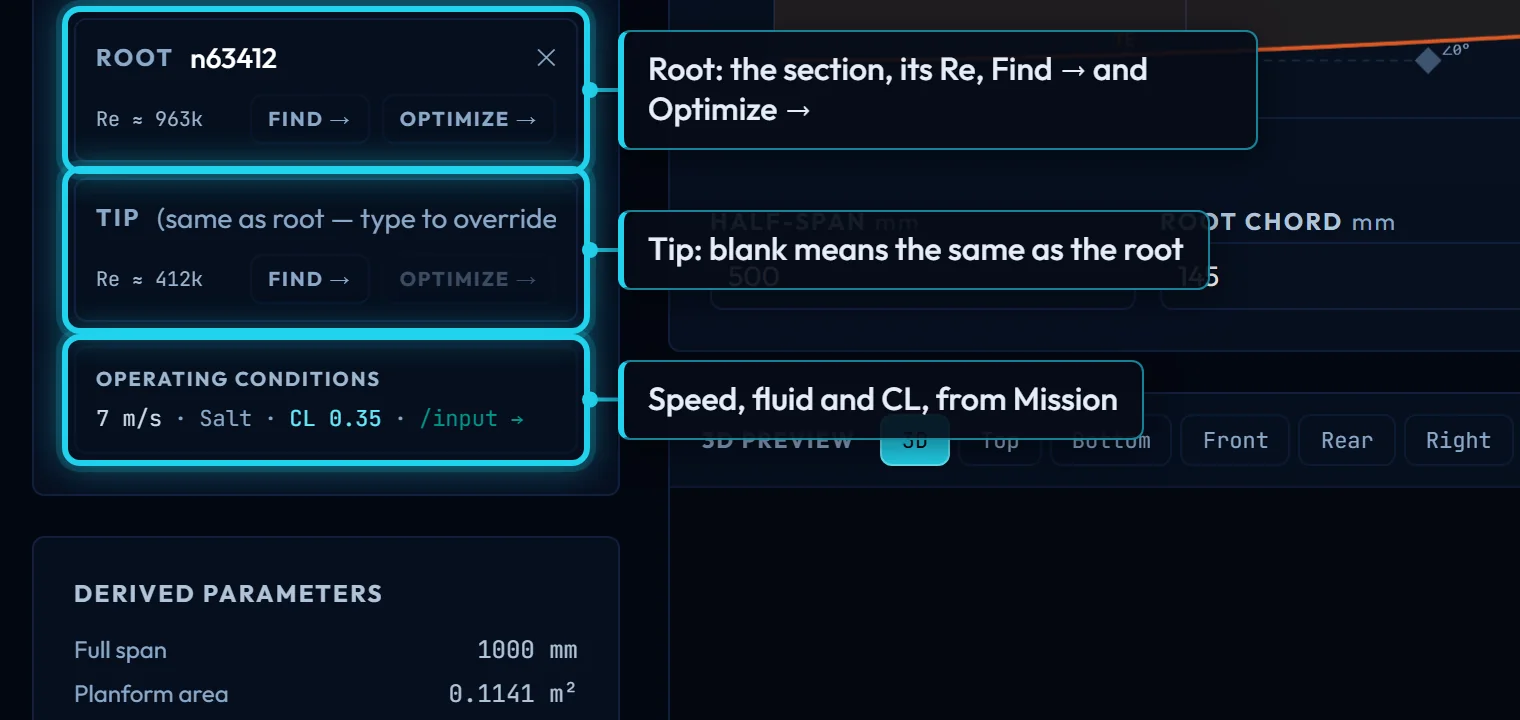
- Wing: the Re ≈ readout beside each section is computed from that section's chord, the operating speed and the fluid.
- Optimize: each operating point carries its own Re.

Transcript
- Re ≈ beside each section is computed from that section's chord, the operating speed and the fluid: the freeride root at 145 mm and 7 m/s in salt water.
- Change the chord and it follows; the tip, with its shorter chord, sits lower.