Ncrit
Ncrit sets how readily the boundary layer on a section is taken to turn turbulent. Every polar on this site is computed at three values, 1, 4, 9, and the charts default to 9.
What it is
NeuralFoil, like XFoil before it, decides where laminar flow becomes turbulent with the e^N method: small disturbances in the boundary layer grow downstream, and transition is declared where their amplification reaches e^N. Ncrit is that N.
- A high Ncrit means disturbances must grow a lot before transition, so laminar flow runs further along the chord. That is a quiet freestream and a smooth surface.
- A low Ncrit means transition comes early. That is a rough or dirty surface, a turbulent inflow, or vibration.
It is a property of the flow and the surface, not of the section. The same section at the same Reynolds number gives a different polar at each Ncrit, which is why the stored sweep carries all three.
Which value to use
- 9 is the conventional value for a clean wind tunnel and the standard for comparing sections. It is the default on every chart here and the value every summary figure (max Cl, best L/D, min Cd) is read at. Use it unless you have a reason not to.
- 4 stands for a rougher surface or a more turbulent flow: a painted wing with some texture, a propeller wash, water with some chop.
- 1 is the pessimistic case: transition almost at the leading edge. Useful as a lower bound, or for a surface you know is rough.
The XFoil manual gives ranges for named conditions: a sailplane in still air 12–14, a motor glider 11–13, a clean tunnel 10–12, an average tunnel 9, a dirty tunnel 4–8. The three stored values bracket the cases that matter for most builds; a live run on the foil page uses whichever Ncrit the chart is set to.
What changing it moves
Mostly the drag bucket, not the lift curve. Earlier transition thickens the turbulent boundary layer, which raises skin friction and narrows the low-drag range; the lift-curve slope and the zero-lift angle barely move. At low Reynolds numbers (below a few hundred thousand) the picture is less tidy, because a laminar separation bubble can be shortened by earlier transition and the drag may go down when Ncrit goes down.
The stored sweep shows both effects. These are measured from the polars on this site, not a rule of thumb:
| Re | CD min · Ncrit 1 | Ncrit 4 | Ncrit 9 | (L/D) max · Ncrit 1 | Ncrit 4 | Ncrit 9 |
|---|---|---|---|---|---|---|
| 100k | 0.0145 | 0.0132 | 0.0159 | 42 | 48 | 50 |
| 200k | 0.0120 | 0.0096 | 0.0100 | 52 | 61 | 67 |
| 500k | 0.0101 | 0.0077 | 0.0064 | 68 | 75 | 88 |
| 1M | 0.0091 | 0.0071 | 0.0055 | 81 | 85 | 100 |
Source: Stored NeuralFoil polars for naca2412 (https://foil.tools/api/polars/naca2412), read 2026-11-05; minimum CD and best L/D over α -5° to 15°.
| Re | CD min · Ncrit 1 | Ncrit 4 | Ncrit 9 | (L/D) max · Ncrit 1 | Ncrit 4 | Ncrit 9 |
|---|---|---|---|---|---|---|
| 100k | 0.0133 | 0.0123 | 0.0153 | 49 | 55 | 55 |
| 200k | 0.0113 | 0.0088 | 0.0091 | 62 | 69 | 75 |
| 500k | 0.0098 | 0.0071 | 0.0058 | 78 | 87 | 99 |
| 1M | 0.0089 | 0.0067 | 0.0049 | 89 | 102 | 115 |
Source: Stored NeuralFoil polars for sd7037 (https://foil.tools/api/polars/sd7037), read 2026-11-05; minimum CD and best L/D over α -5° to 15°.
Read a row left to right. At 100k the NACA 2412 has less minimum drag at Ncrit 4 than at 9, because the earlier transition shortens its separation bubble; by 500k the order has flipped and Ncrit 9 is cleanest, as the textbook says. The SD7037, a low-Reynolds section designed to avoid the bubble, behaves more evenly. The lesson for a builder: at a low Reynolds number, test the Ncrit that matches your surface rather than assuming 9 is the optimistic case.
Where to set it
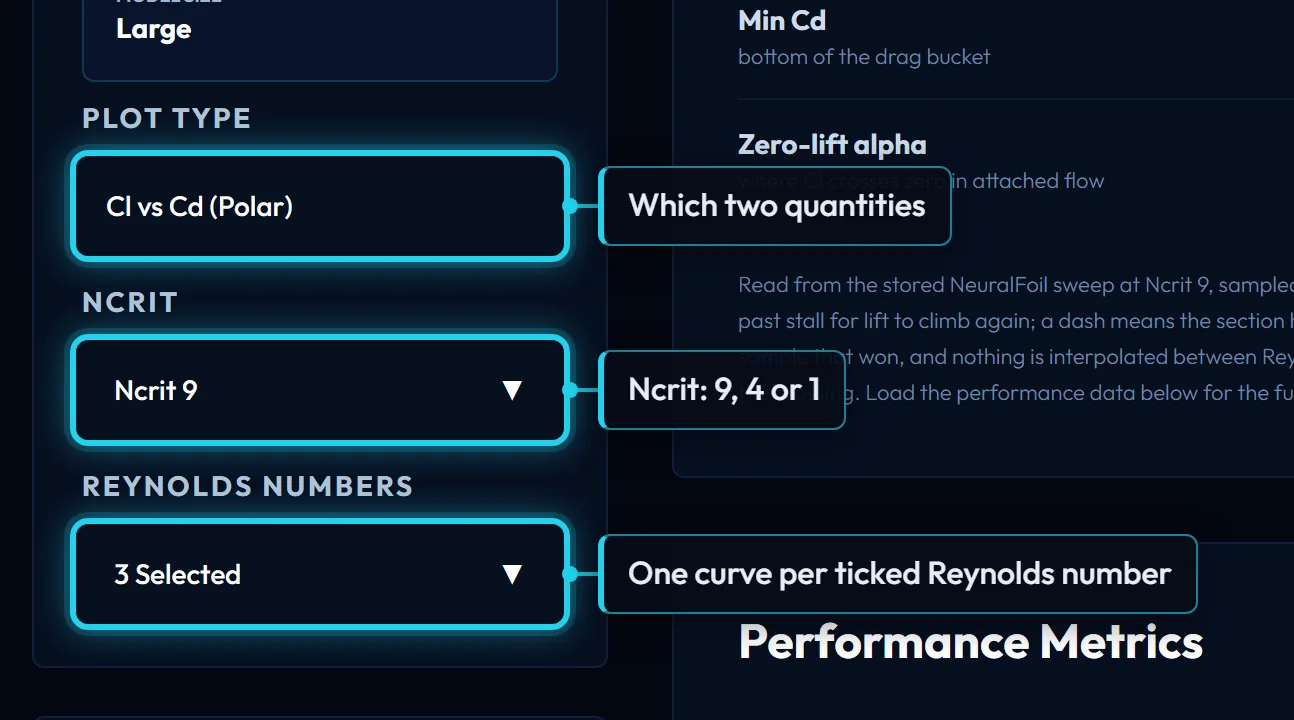
- Foil page: the Ncrit dropdown above the chart. It filters the stored polars and is sent with a live run.
- Compare: the Ncrit select in the analysis options; library sections keep their stored polars at the chosen Ncrit.
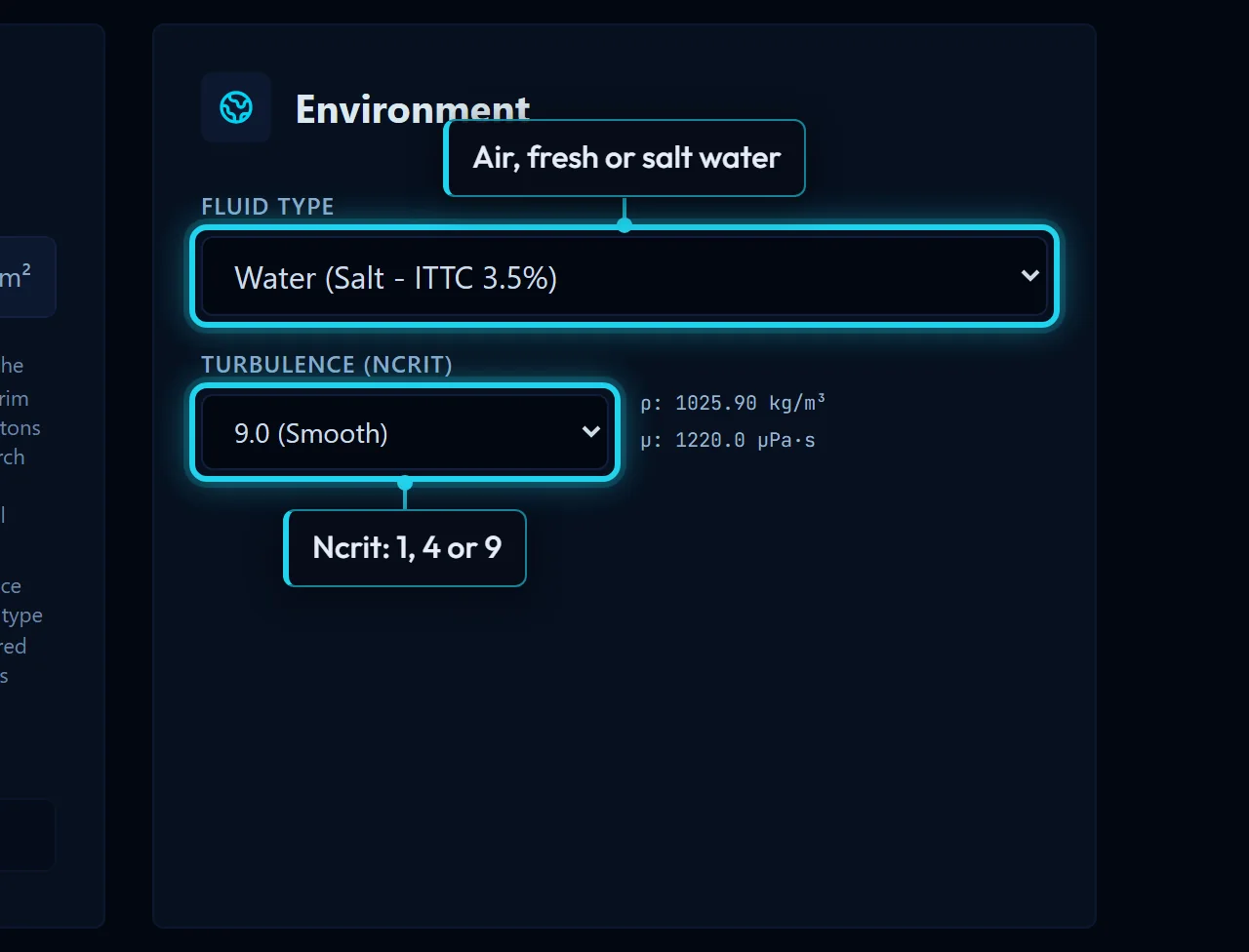
- Mission: "Turbulence (Ncrit)", which the selector passes to the polar lookup.
- Optimize: under Advanced.
Transcript
- Every section is stored at Ncrit 1, 4 and 9. The chart opens at 9, the clean-tunnel standard.
- Ncrit 1 puts transition almost at the leading edge: the drag bucket narrows and the lift curve barely moves.
- Ncrit 4 stands for a rougher surface or a more turbulent flow, between the two.
- Back to 9. Pick the level that matches your surface and your air or water; choppy water reads the Ncrit 4 curve.