Trim
A wing on its own answers what one surface does. Trim asks the next question: does the rig fly level with the rider where the rider is? A main wing, a stabiliser and a centre of gravity are solved together, and the answer is the angle the craft flies at, the stabiliser setting that balances it, the load on each surface, the thrust the drag demands, and how stable the balance is.
What a template holds
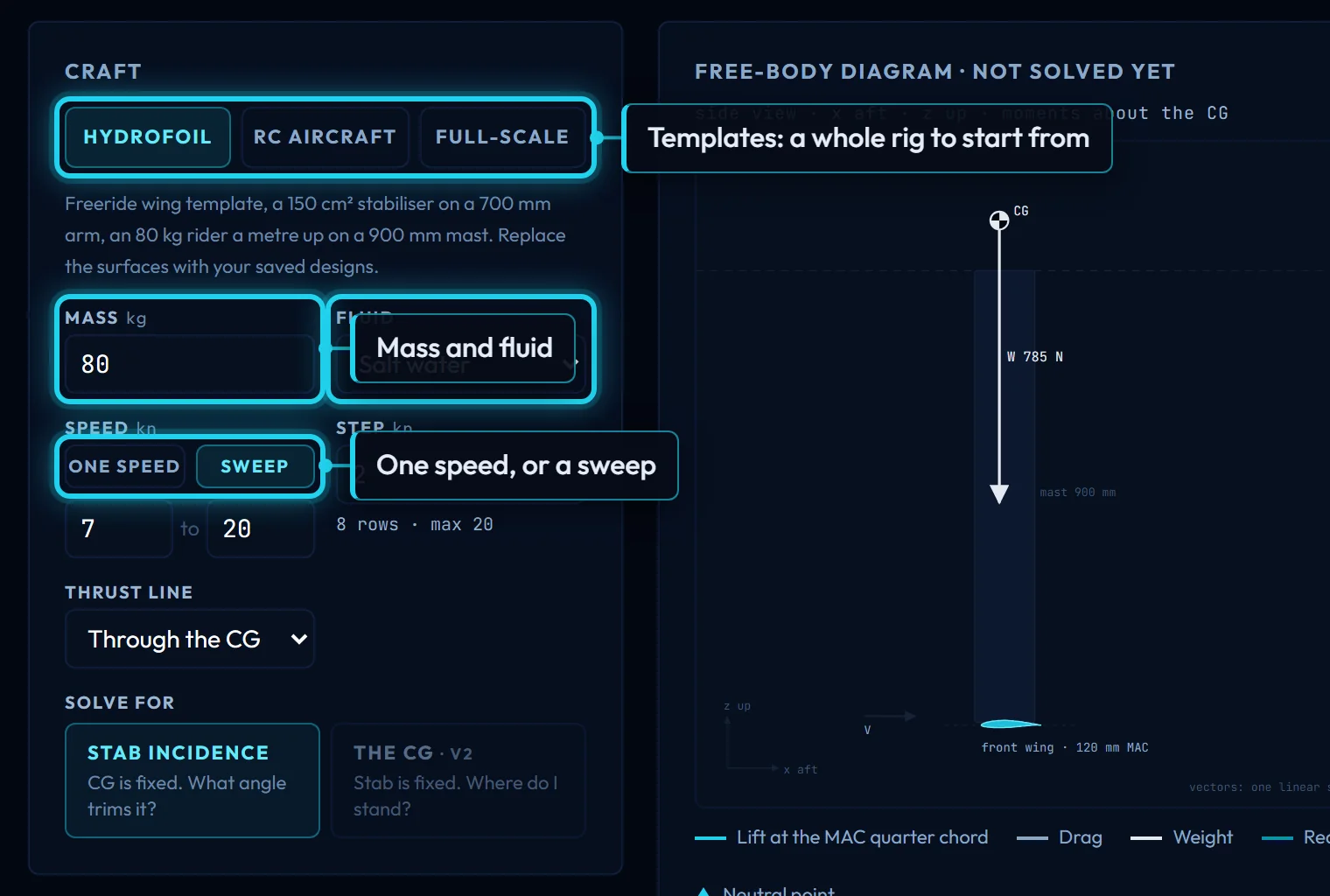
The page opens on a template so there is a complete rig to solve. The hydrofoil template is the running example: the Freeride wing, a 150 cm² AR 7 stabiliser (naca0008) on a 700 mm arm, 80 kg at 1 m up on a 900 mm mast of 120 mm chord, the CG at 30% of the wing MAC, salt water, 12 kn, a sweep of 7–20 kn. The RC and full-scale templates seed the same inputs for a trainer and a Cessna-class single. A template supplies inputs, never a design: its stabiliser is a plain generated panel meant to be replaced with a saved wing. Switching templates resets the craft.
The craft
Mass is everything the lift must carry. Fluid sets density and viscosity for every surface and the mast. Speed is one trim point or a sweep from a low to a high speed in steps, capped at 20 rows. The speed unit, m/s or knots, applies to the inputs, the row list and the chart. The thrust line passes through the CG, adding no moment, or acts at a height z with its arm in the balance. Solve for is fixed on this page: the CG stays put and the free surface's incidence is solved; the inverse lives in the connector tool.
The surfaces
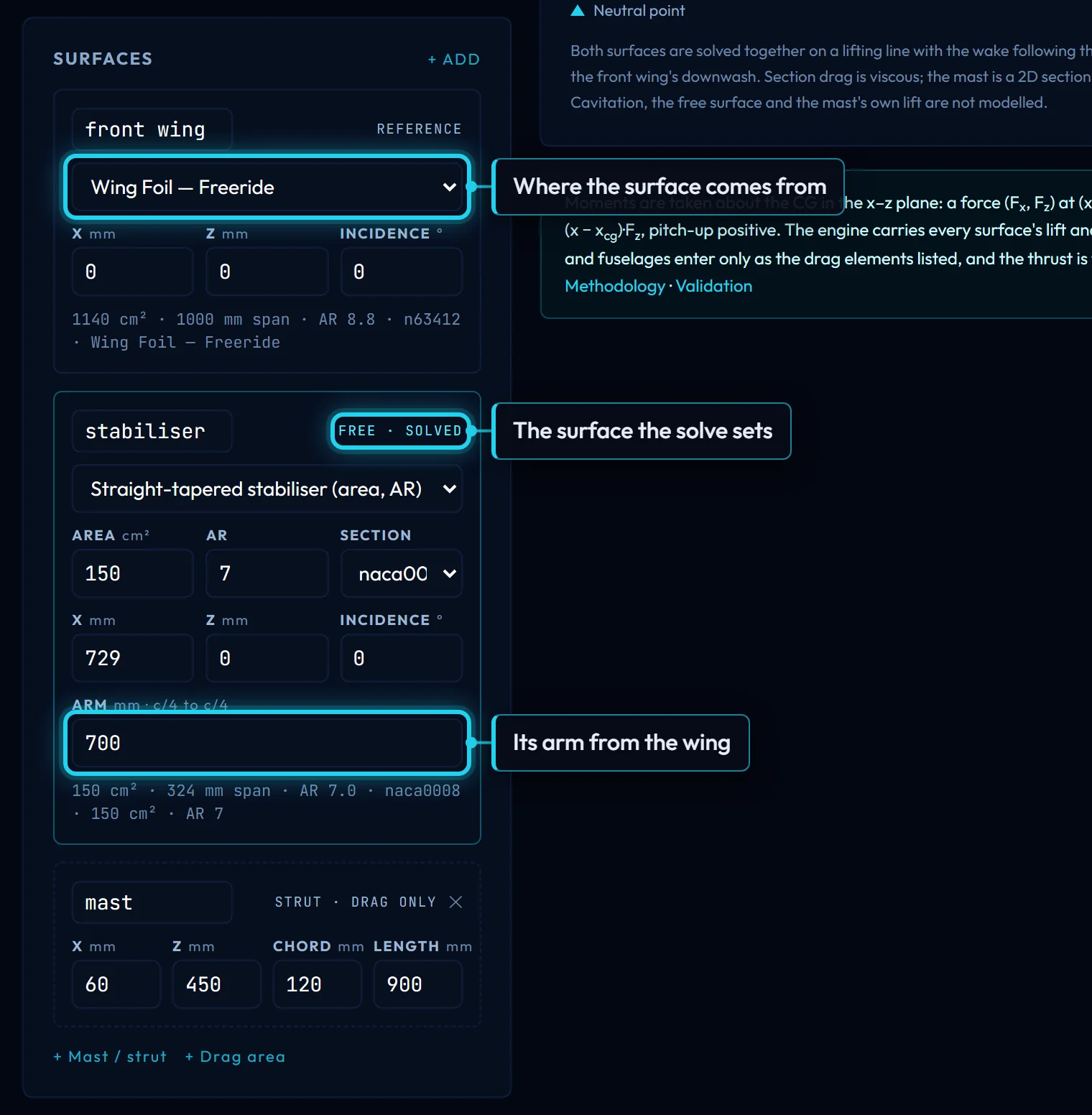
Each surface is a full designer document placed by its root leading edge at x and z in the craft frame, x aft of the main wing's root leading edge, z up. Source picks where it comes from: a saved design, a generated straight-tapered stabiliser from Area, AR and a symmetric Section, or a reference template. Incidence is the setting angle; Arm is MAC quarter chord to MAC quarter chord, and typing it moves x. Exactly one surface is marked free: its incidence is what the solve sets, and the reference wing is never that surface.
Masts, pods and drag areas
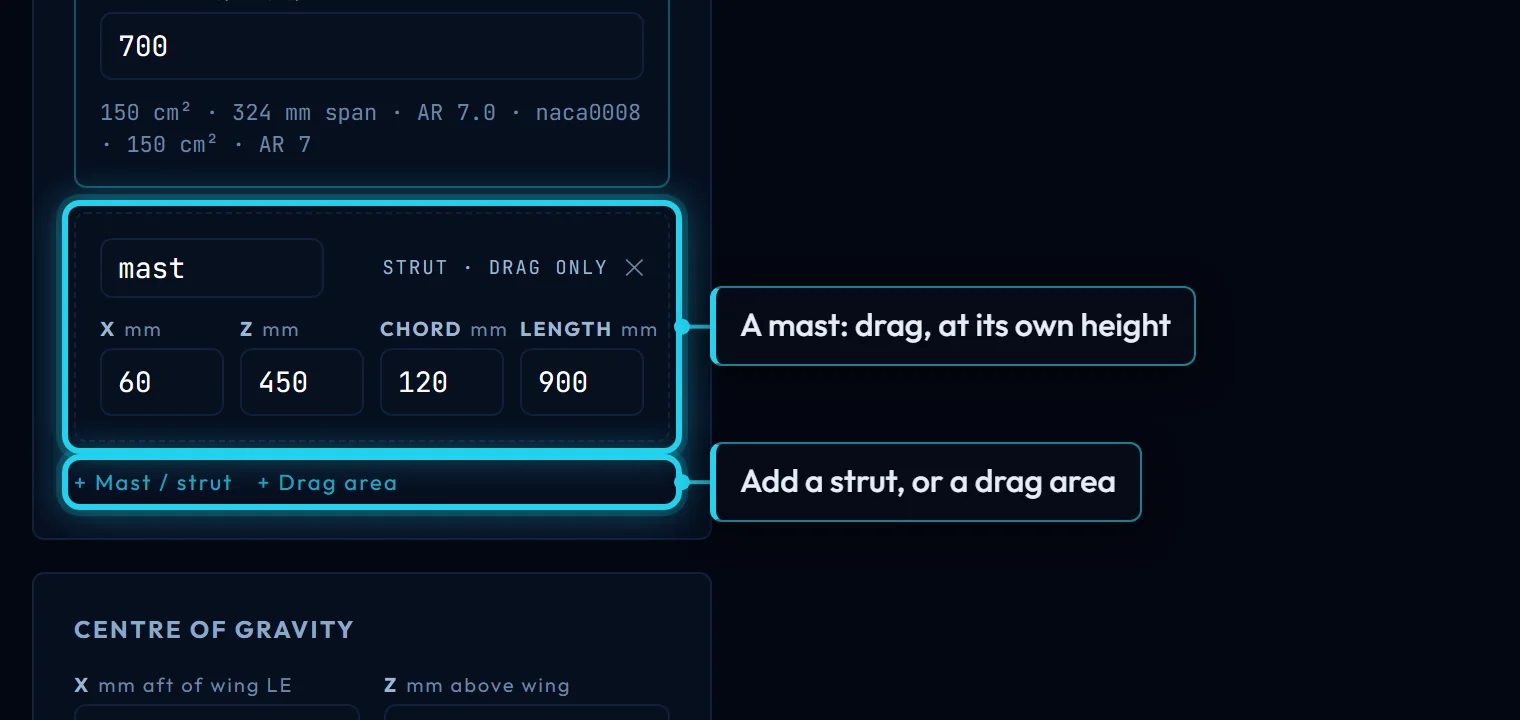
Non-lifting parts enter as drag with a height. A mast or strut is a symmetric section at its own Reynolds number, drag q · chord · length · Cd, at the middle of its immersed length. A board, pod or fuselage is a drag area CD·A at a point. Each adds to the thrust and a moment through its height, and nothing to the pitch stiffness, so the static margin does not see them.
The centre of gravity
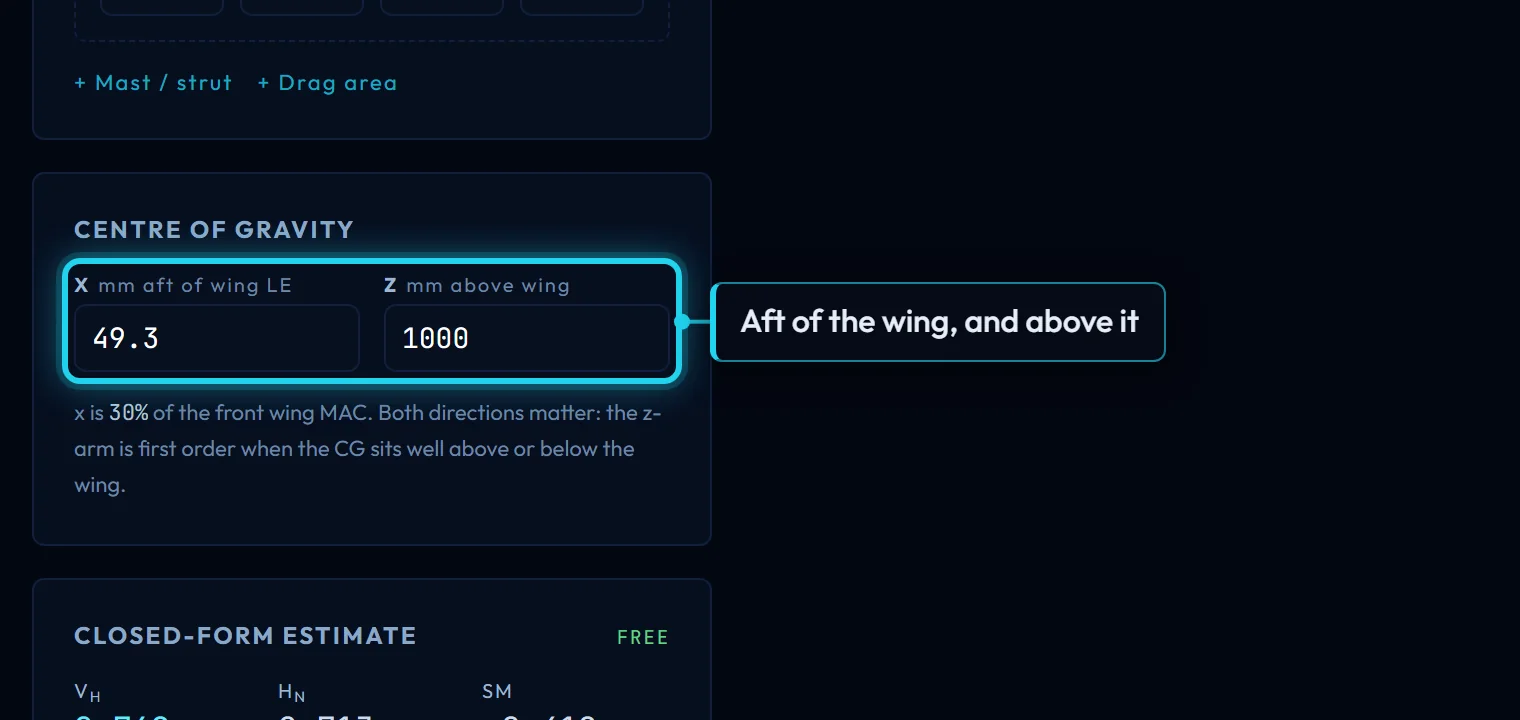
CG x is aft of the wing's root leading edge and is shown as a percentage of the wing MAC. CG z is its height above the wing. Both matter: on a hydrofoil the rider is a metre up, and the lift's forward component at angle of attack times that height is a pitching moment that bites at low speed.
The free estimate
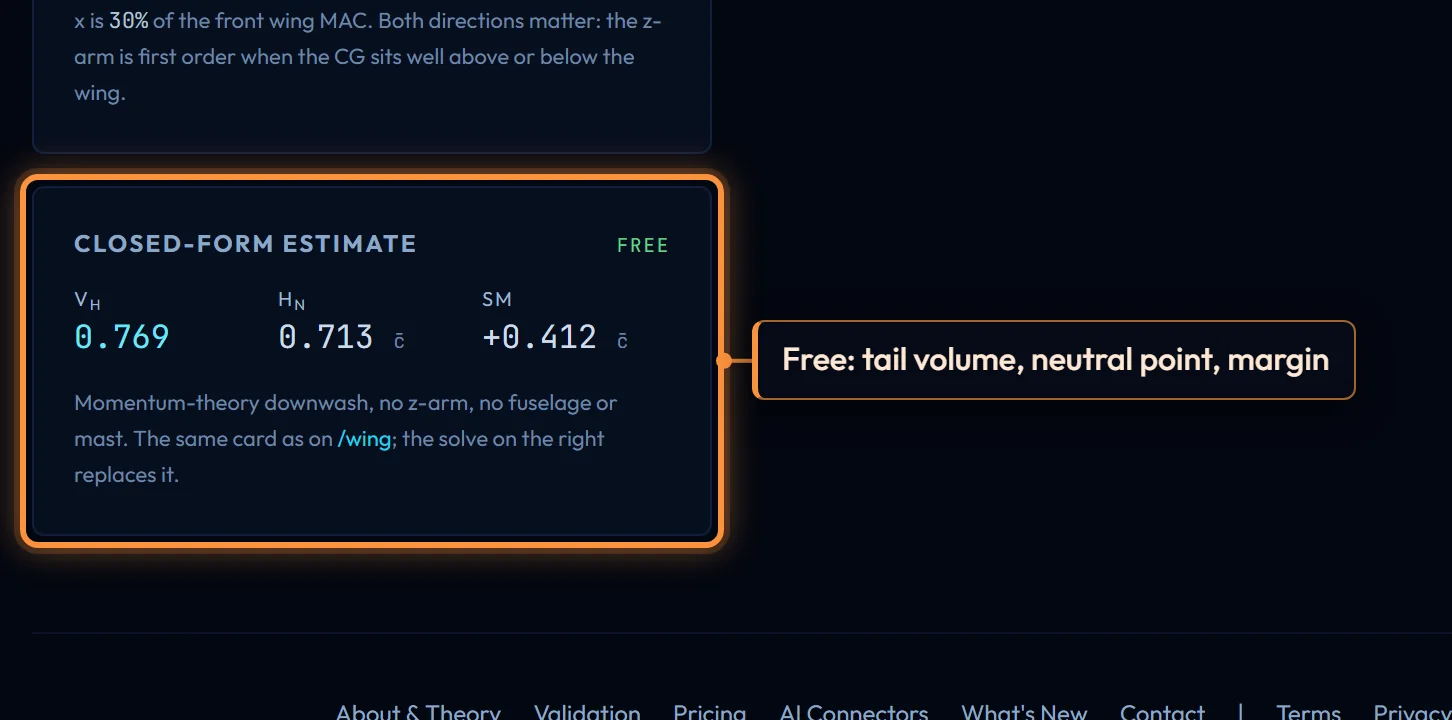
Beside the inputs is the designer's stabiliser card evaluated for the same geometry, free: tail volume V_H = S_h · l_h / (S · c̄), a stick-fixed neutral point h_n from a momentum-theory downwash, and the static margin h_n − h_cg. It has no z-arm and no solved downwash, which is what the solve adds.
The solve
Transcript
- The hydrofoil template is the whole rig: the freeride wing, a 150 cm² stabiliser on a 700 mm arm, the rider a metre up on a 900 mm mast, at 12 knots.
- The centre of gravity is the rider: a metre above the wing. That height is what makes a hydrofoil's balance different from an aeroplane's.
- Solve finds the wing angle and the stabiliser setting that fly level at 12 knots, and reports the static margin; too little margin means moving the CG or the stabiliser.
Solve meshes every surface into one lifting line with the wake following the flow, so the stabiliser flies in the main wing's downwash rather than in free air, and solves two equations in two unknowns: lift equals weight, and the moment about the CG is zero. Sections are viscous through NeuralFoil; drag is the induced term plus profile drag plus the elements. A speed the craft cannot fly is refused with a reason, not trimmed silently. Not modelled: the free surface and cavitation, a mast's own lift, the fuselage's destabilising moment, flex, and roll or yaw; the full list is on What the analyses model. A trim point takes a few seconds, a sweep up to a minute or two.
The outputs
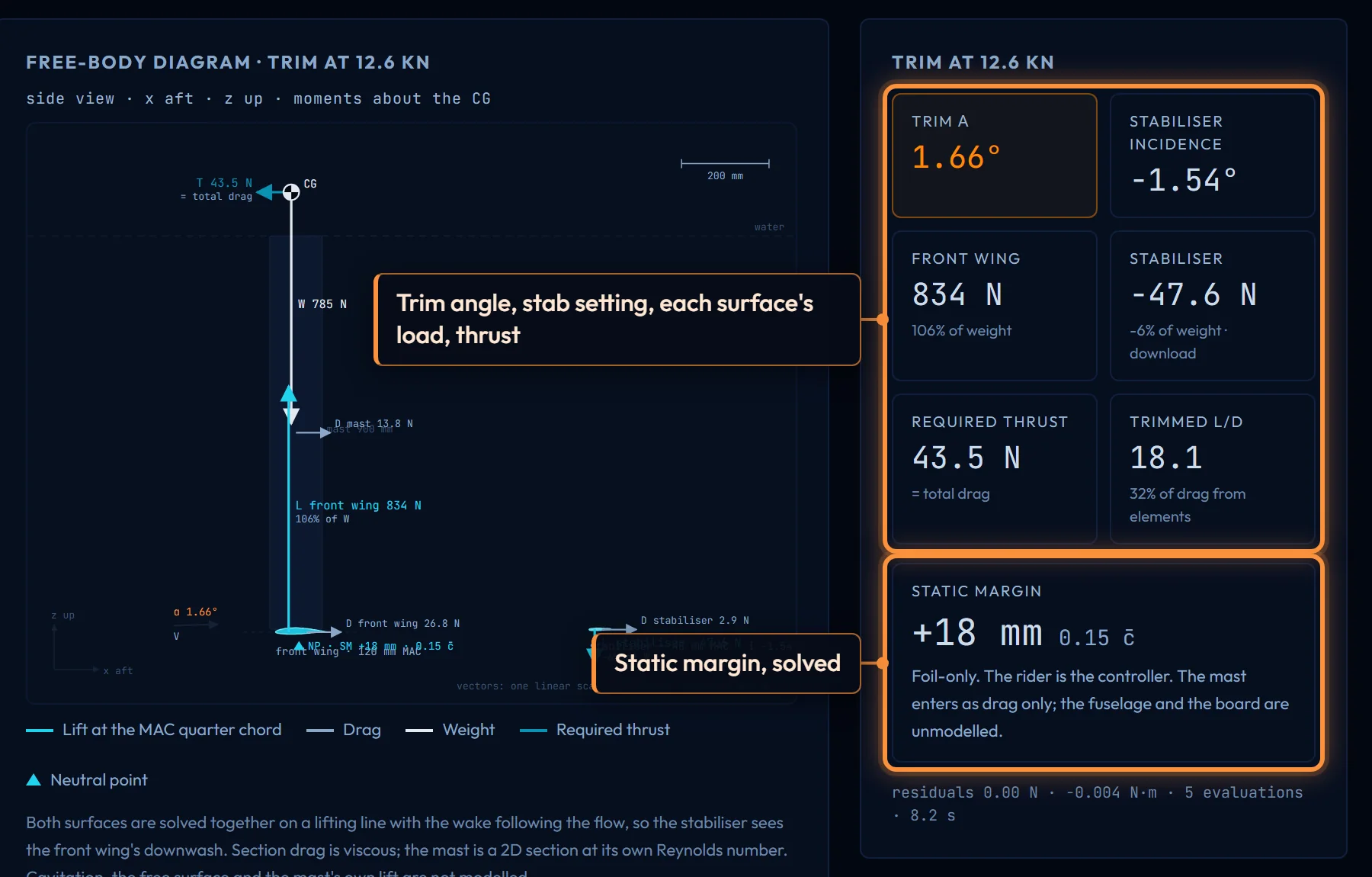
Trim α is the body angle at this speed; Stab incidence the free surface's solved setting; each surface's load in newtons and as a share of the weight, a negative load being a download the wing then carries on top; Required thrust equals total drag; Trimmed L/D is for the whole craft. The residuals line says how closely the solve closed. A sweep adds a row per speed and a chart of α and incidence against speed.
Static margin, in one unit
Static margin is the neutral point's distance aft of the CG as a fraction of the main wing's mean chord c̄; positive is statically stable. The same number appears in three dresses: the free estimate here as a fraction of c̄, the stabiliser card on the wing designer as a percentage of MAC (the fraction times 100), and the solve as millimetres (the fraction times c̄) with the fraction beside it. On a hydrofoil the rider is the controller, so the margin is reported with no verdict; on an aircraft the omitted fuselage moves the real neutral point forward by roughly 0.05–0.10 c̄.
What it costs
Trim is paid-only: 2 credits for a trim point and 3 for a sweep, from your credit balance, with no free monthly allowance. Building the craft and reading the estimate are free. Nothing is charged until the solver answers; a sweep refused on every row is not charged. See pricing.
Back to the wing
Too much margin and the stabiliser works hard for nothing; too little and the rider is doing its job. Move the CG, change the arm or the stabiliser's area, and solve again. If the main wing's load or pitching moment is the problem, that is the wing and its section, not the rig.
What this hands on
A trim angle, a stabiliser setting and a static margin for the rig as built, saved to your Dashboard with Save this trim, and a stabiliser load you can take back to Mission as a constraint point when choosing its section.
Controls on this page
| Control | What it does | Units |
|---|---|---|
| Craft | Three starting rigs: hydrofoil (the rider a metre up on a mast), RC and full-scale. A template seeds every input; its stabiliser is a plain generated panel meant to be replaced by a saved design. Switching resets the craft. | |
| Mass | Everything the lift must carry: craft, rider, payload. The solve sets the lift of all surfaces together equal to mass × g. | kg |
| Fluid | Air, salt water or fresh water: density for the dynamic pressure, viscosity for each section's Reynolds number, the mast's included. | |
| One speed / Sweep | One speed solves a single trim point (2 credits). Sweep solves a row at each speed from the low to the high value, the trim-vs-speed curve (3 credits, up to 20 rows). | |
| Speed | The speed to trim at, in the unit chosen beside it; in Sweep, the first and last speeds. A template opens at the speed its rig was sized for. | m/s or kn |
| Speed unit | m/s or knots for every speed on this page: the inputs, the row list and the chart. The request is sent in m/s. | |
| Step | Spacing between sweep speeds. Rows = (high − low) ÷ step + 1, capped at 20; widen the step when the count turns amber, or the route refuses the request. | |
| Thrust line | Where the thrust acts in z. Through the CG adds no moment. At a height z puts the thrust's arm into the balance: nose-up or nose-down as the line sits below or above the CG. | |
| Thrust z | Height of the thrust line, up positive, in the craft frame whose origin is the main wing's root leading edge. | |
| Solve for | The solve sets the free surface's incidence with the CG fixed. The inverse, where do I stand with the stabiliser fixed, is in the connector tool (analyze_trim, free: cg) and comes to this page later. | |
| Source | Where a surface's geometry comes from: one of your saved wing designs, a generated straight-tapered stabiliser from area and aspect ratio, or a reference template. Each is a full designer document. | |
| Area | Planform area of the generated stabiliser, both halves. With the aspect ratio it fixes the span, b = √(AR · S), and with the taper the chords. | cm² or m² |
| AR | Aspect ratio of the generated stabiliser, span² over area. The usual band for a tail is 3–5: responsive without stalling before the wing. | |
| Section | The symmetric library section the generated stabiliser is built from. Thinner means less drag and an earlier stall; the solve reads its polar at the tail's own Reynolds number. | |
| x | The surface's root leading edge, aft of the reference wing's root leading edge. Typing the Arm moves this instead. | mm or m |
| z | Height of the surface's root leading edge, up positive. On the hydrofoil template the stabiliser sits level with the wing and the rider a metre above both. | mm or m |
| Incidence | Setting angle of the surface, nose-up positive. On the free surface it is only the starting value: the solve replaces it. | deg |
| Arm | Main-wing MAC quarter chord to this surface's MAC quarter chord: the tail-volume card's l_h. Typing here moves x so the arm comes out as typed. | mm or m |
| free · solved / fixed | Marks the one surface whose incidence the solve sets; the others keep theirs. The reference wing is never free. Pick the stabiliser. | |
| x | Where a drag element acts, aft of the wing root leading edge. Its drag times its height above or below the CG is a moment the balance carries. | mm or m |
| z | Height of the element, up positive: for a mast or strut, the middle of its immersed length; for a drag area, where the drag acts. | mm or m |
| Chord | Chord of the mast or strut. With the speed and the fluid it sets the section's own Reynolds number, which fixes its drag coefficient. | mm or m |
| Length | Immersed length of the mast or strut. Drag is q · chord · length · Cd of a symmetric section at its own Re; no lift and no side force. | mm or m |
| CD·A | A board, pod or fuselage as a drag area: drag = q · CD·A at the point given. It adds to the thrust and a moment through its height, not to the pitch stiffness, so the static margin ignores it. | m² |
| CG x | Centre of gravity aft of the main wing's root leading edge. Moments are taken about it; the caption below converts it to a percentage of the wing MAC. | mm or m |
| CG z | Height of the CG above the wing, up positive. First order on a hydrofoil: the lift's forward component at angle of attack, times this height, is a pitching moment that grows at low speed. | mm or m |
| V_H | Tail volume coefficient, V_H = S_h · l_h / (S · c̄): the tail's area and arm against the wing's area and mean chord. Free and closed-form, the same number as the designer's stabiliser card. | |
| h_n | Stick-fixed neutral point of wing plus tail, as a fraction of c̄ aft of the MAC leading edge, from the tail volume and a momentum-theory downwash. No z-arm, no fuselage or mast. | c̄ |
| SM | h_n − h_cg as a fraction of c̄; positive is statically stable. The solve on the right reports the same quantity with the downwash solved rather than estimated, in mm as well as c̄. | c̄ |
| Trim α | Body angle of attack that carries the weight at this speed with the moment about the CG zero. The reference wing's chord line is the body axis. | deg |
| Stab incidence | The free surface's solved incidence, nose-up positive: the setting that zeroes the moment at this speed. Negative means the stabiliser is set to push down. | deg |
| Surface load | Lift on each surface, and its share of the weight. A negative load is a download on the stabiliser, which the main wing then carries on top of the weight. | N |
| Required thrust | The thrust that closes the x-balance, T = total drag: every surface's induced and profile drag plus the masts, pods and drag areas. | N |
| Trimmed L/D | Lift over drag for the whole craft at this trim point. The caption says how much of the drag is induced, or how much comes from the drag elements when there are any. | |
| Static margin | Neutral point aft of the CG, as a fraction of the main wing's c̄ and in mm; positive is statically stable. Wing plus tail only: masts and pods move the thrust and the loads, not this. | c̄ and mm |
| Residuals | How closely the solve closed: lift minus weight in N and the moment about the CG in N·m, then the solver evaluations it took and the sidecar's time. | |
| Trim vs speed | One row per sweep speed: trim α, the free surface's setting and the static margin in mm. A refused row could not carry the load, or needed an angle outside the ±20° window the section model is trusted in. | |
| Solve | Runs the lifting-line solve on both surfaces together. 2 credits a trim point, 3 a sweep, from your balance: trim has no free allowance. Nothing is charged until the solver answers, and a sweep refused on every row is not charged. |