Kulfan Airfoil Visualizer

Interactive visualization of CST (Kulfan) parameterized airfoils. Adjust parameters to see real-time updates.

Kulfan Airfoil Theory

Class-Shape Transformation (CST) Method

The Kulfan parameterization, also known as Class-Shape Transformation (CST), provides a powerful method for representing airfoil geometries using a small number of parameters. This approach separates the "class" function (which defines the general shape characteristics) from the "shape" function (which defines the specific geometry).

Mathematical Formulation

The airfoil coordinates are defined by:

y(x) = C(x) × S(x) + x × tte

where:

  • C(x) is the class function
  • S(x) is the shape function
  • tte is the trailing edge thickness

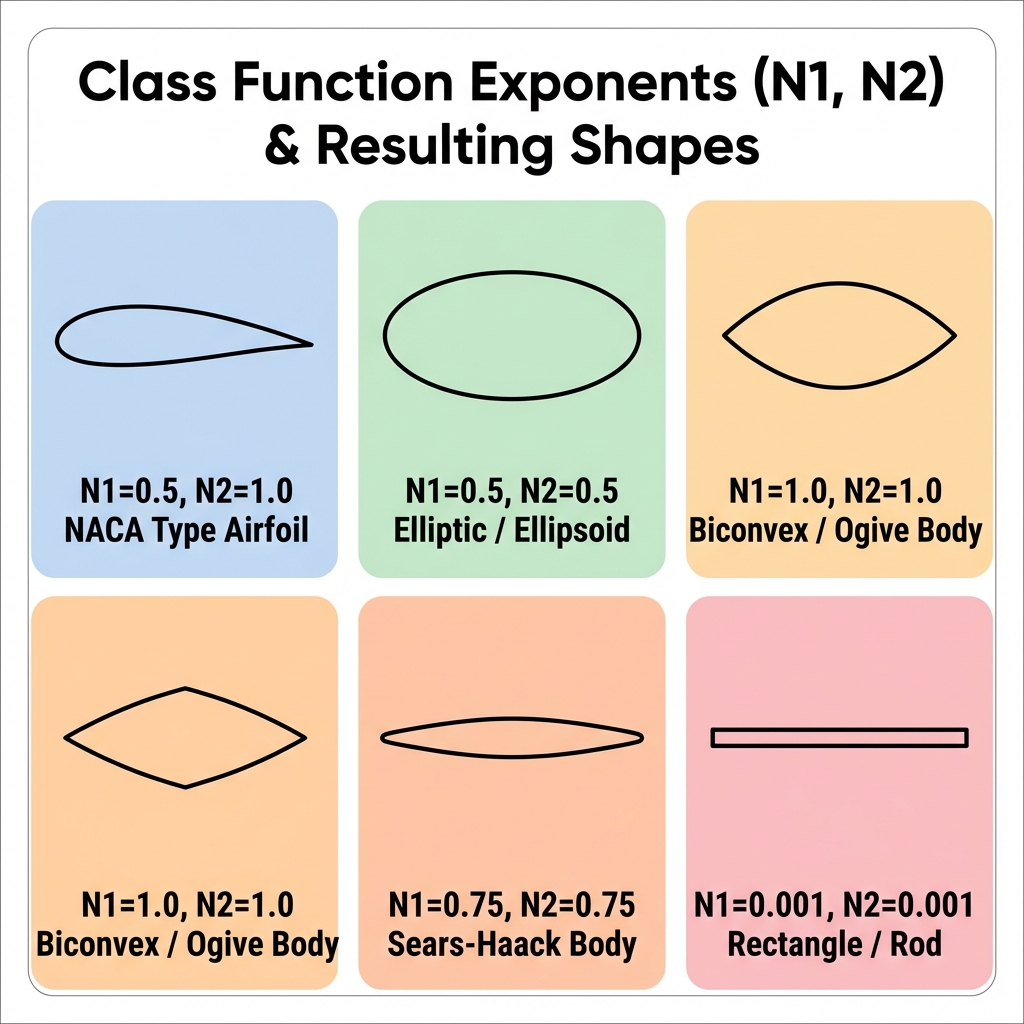
Class Function

The class function defines the basic airfoil shape:

C(x) = xN1 × (1-x)N2
  • N1 (Leading Edge): Controls leading edge radius. Lower values (0.3-0.5) create rounder leading edges, higher values (0.6-0.8) create sharper leading edges.
  • N2 (Trailing Edge): Controls trailing edge shape. Values around 1.0 give typical airfoil trailing edges.

Shape Function

The shape function uses Bernstein polynomials:

S(x) = ∑i=0n Ai × Bi,n(x)

where Bi,n(x) are Bernstein basis polynomials and Ai are the shape weights.

Thickness and Camber

The thickness and camber are controlled by scaling factors applied to the shape function:

  • Thickness Factor: Scales the overall thickness of the airfoil
  • Camber Factor: Adds camber by combining upper and lower surface modifications

Parameter Relationships

The sliders in this visualizer directly control:

  • N1 Slider: Leading edge class parameter (0.3-0.8)
  • N2 Slider: Trailing edge class parameter (0.5-1.5)
  • TE Thickness: Trailing edge thickness as % of chord
  • Leading Edge Weight: Additional leading edge shape modification
  • Thickness Factor: Overall thickness scaling
  • Camber Factor: Camber adjustment
  • Bernstein Weights: Shape function coefficients for upper and lower surfaces

For more details, see: Kulfan, B.M. (2008). "Universal Parametric Geometry Representation Method." Journal of Aircraft, 45(1), 142-158.

General Parameters

Controls the leading edge radius. Lower values make it more rounded.
Controls the trailing edge shape. Higher values make it sharper.
Trailing edge thickness as percentage of chord.

Geometry Modifiers

Modifies the leading edge shape.
Adjusts the thickness of the airfoil.
Adjusts the camber of the airfoil.

Bernstein Weights

Bernstein polynomial weights for upper and lower surfaces. Default gives NACA0012-like shape.

File & Database

Fit Kulfan parameters to a .dat file.
Load from built-in database.

Export Tools

DXF (Scaled) or DAT (Normalized) export.

Kulfan Parameters Summary

JSON representation of the current airfoil parameters.